
You press the wall button before work, the door lifts four inches, and then everything stops. Pressing the button again may send it back down, leave it humming, or produce nothing more than a click.
Grand River Garage Door helps homeowners in Lansing and across Central Michigan sort out this failure. The goal is a clear explanation, an honest recommendation, and a no-pressure quote, not a guess based on one symptom.
The first decision is whether the door is safe to operate again. A broken spring, loose cable, crooked door, or door that suddenly feels extremely heavy is a hard stop: No. Stop using the door.
Start With a Quick Symptom Check
If the door rises several inches and a spring has a visible gap, or if it lifts unevenly with a loose cable, No. Stop using the door. Those signs point to the counterbalance system rather than a simple opener setting.
If the level door catches at the same height, look from a safe distance for loose debris near that point. Do not touch tracks, rollers, brackets, springs, or cables.
If the issue happens near the floor during closing, the photo eyes or reversing system may be involved. During a cold snap, visible ice may add resistance, but never force the door.
Do not keep pressing the remote to “help” the opener through the problem. Repeated attempts can damage the opener or door hardware.
1. A Broken or Weakened Spring
The opener does not lift the full weight of the door by itself. The spring system counterbalances most of that weight, allowing the opener to guide a properly balanced door through its travel.
When a torsion spring breaks, the door may rise only a few inches before the opener’s safety limits stop the effort. A visible gap in a spring mounted above the door is a strong clue, but the absence of an obvious gap does not prove that the spring system is sound.
A weak or improperly balanced spring can create a similar symptom. The U.S. Consumer Product Safety Commission says an improperly balanced door should be serviced by a trained professional (CPSC garage-door safety guide).
Can you repair or adjust the spring yourself? No. Stop using the door. Springs, winding cones, drums, bottom brackets, and attached cables are part of a tension system that can release force suddenly.
Grand River provides broken spring replacement in Lansing and surrounding communities. Leave the door closed, keep people and pets away, and arrange an inspection.
2. A Cable, Drum, or Crooked-Door Problem
Lift cables transfer spring force to the bottom of the door. If a cable slips, frays, or leaves its drum, one side may rise while the other side stays low.
That uneven movement can make the door bind after only a few inches. You may notice a tilted bottom edge, slack cable near one track, a roller pulling away from the track, or a sharp scraping sound.
Do not pull the emergency release to test a visibly crooked door. Disconnecting an unstable door can allow it to drop or shift unexpectedly.
Is this a DIY repair? No. Stop using the door. Do not touch the cable, drum, bottom bracket, spring, or track fasteners, and do not try to level the door with clamps or tools.
If a vehicle is trapped or the opening cannot be secured, request emergency garage door repair. Explain whether the door is crooked, partly open, or blocking access.
3. A Track Obstruction or Damaged Roller
A small object, packed debris, bent track section, or damaged roller can stop the door at a repeatable point. The opener may lift the door normally until the affected roller reaches that location.
From a safe distance, look along both vertical tracks for an obvious obstruction. You may remove a loose object sitting on the garage floor if you can do so without standing under the door or touching the tracks, rollers, cables, brackets, or springs.
Do not loosen track bolts or hammer a track back into shape. The tracks guide a large moving door, and alignment work requires checking the whole system rather than forcing one section to look straight.
If the door is crooked, heavy, hanging unevenly, or has a roller outside the track, No. Stop using the door. If it is level but catches at the same place, a garage door repair inspection can distinguish a damaged roller from track, hinge, or balance trouble.
4. An Opener Travel or Force Problem
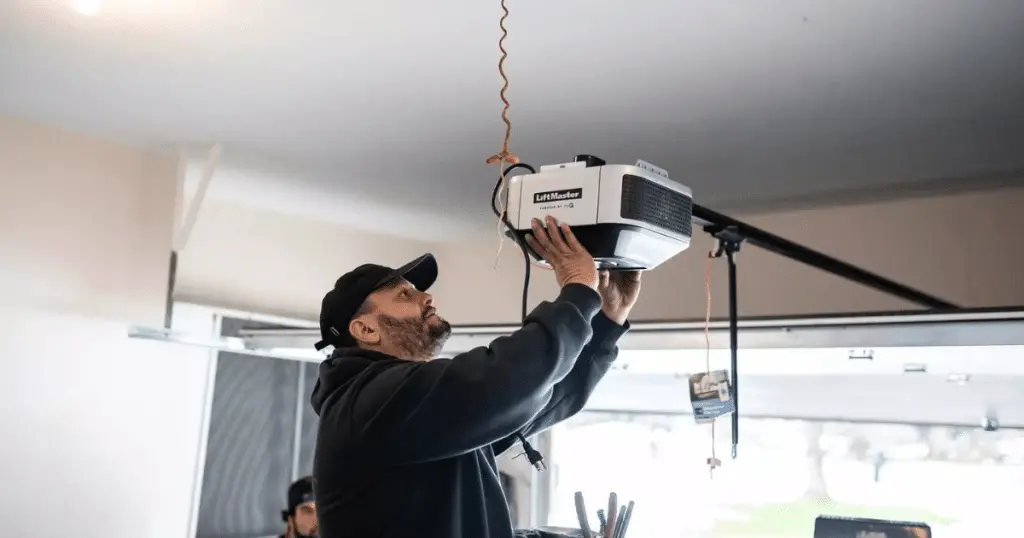
An opener uses travel settings to determine where the door should stop and force monitoring to recognize resistance. Incorrect settings, a failing motor component, or internal wear can cause the unit to stop before the door reaches its open position.
Note whether the opener light flashes, the motor hums, or the trolley stops at the same point each time. Do not open the housing or alter force settings to overcome resistance.
Increasing force can mask a binding or unbalanced door rather than fix it. CPSC guidance emphasizes that the reversing system, springs, hardware, and door balance should be inspected regularly, with professional service for an unbalanced door.
Electrical diagnostics, capacitors, motor assemblies, and logic-board work are not DIY. Grand River’s garage door opener repair service covers cases where the door hardware appears stable but the operator cannot complete its cycle.
5. The Door Is Reversing on the Closing Cycle
Photo eyes monitor the doorway during closing. They should not stop a normal opening cycle, so confirm whether the door truly stops while rising or starts down, reverses, and returns several inches upward.
If the problem happens during closing, check whether both sensor indicators match the manufacturer’s instructions and whether a stored item, cobweb, dirt, or moisture blocks either lens.
You may gently wipe the lens with a clean, soft cloth and move objects out of the beam. Do not bypass the sensors, splice wiring, or aim them away from the opening to keep the door moving.
Amarr recommends checking photo eyes and testing the opener’s reversing function as part of routine care, while directing adjustment and repair needs to a qualified garage-door dealer (Amarr maintenance guidance). If cleaning does not restore normal operation, stop testing and schedule service.
6. Ice, Cold, or Weather-Related Resistance
Central Michigan weather can add resistance at the threshold or stiffen movement that was already marginal. Water may freeze the bottom seal to the floor, while cold can make existing roller, hinge, balance, or opener problems more noticeable.
Look for visible ice around the bottom seal before operating the door. Do not repeatedly run the opener against a frozen seal, pry the door upward, or pour boiling water on components.
If the door has already lifted several inches, do not work beneath it to clear ice. Keep the area closed off and let a technician evaluate it if the door will not return to a fully closed, stable position.
Weather may explain when the symptom appears, but it does not automatically explain why the opener cannot handle normal travel. A door that remains heavy, crooked, noisy, or inconsistent after visible ice is gone needs inspection rather than more force.
7. A Failing Logic Board or Electrical Component
Intermittent stops can come from a logic board, RPM sensor, wiring fault, motor component, or power issue inside the opener. Lightning, a power interruption, moisture, or age-related component wear may be relevant context, but the symptom alone cannot identify the failed part.
Check only simple external items: confirm the opener is plugged in and replace a remote battery if only the remote fails. If both controls produce the same partial lift, the problem is not limited to one remote.
Logic-board and electrical repair is not DIY. Do not remove the opener cover, touch a capacitor, probe live wiring, or replace safety devices based on an online guess.
A technician should first confirm that the door is mechanically balanced and free of binding. Replacing an opener component before identifying a broken spring or jammed roller can leave the original hazard in place.
What You Can Safely Check Before Calling
Keep the door in its current stable position and stay out from under it. Make a short record for the service call using the observations below.
Record the Door Position
Note whether the door is fully closed, partly open, crooked, or level.
Look Without Touching
From a safe distance, check for a spring gap, loose cable, roller outside the track, or visible obstruction. Do not touch any of those parts.
Record the Opener Response
Write down any opener light pattern, sound, and the height where movement stops.
Check the Photo Eyes
Observe whether both photo-eye indicators appear normal. You may wipe dirty lenses with a soft cloth.
Note Recent Changes
Record any recent ice, impact, power outage, or unusual noise.
Do not perform a manual balance test on a door that is already failing, partly open, crooked, heavy, or showing spring or cable damage. Although CPSC and Amarr describe balance checks for routine inspection of an otherwise stable door, this symptom changes the risk calculation.
What Might the Repair Cost?
Grand River’s currently published pricing guide gives a general garage-door repair estimate of $100 to $600, depending on the issue (garage door repair cost guide). That range is a planning estimate, not a quote for this symptom.
Price can move based on the failed part, door weight, spring configuration, opener model, damage, parts availability, and urgency. A partial-opening symptom may involve connected problems.
A useful quote should follow an actual diagnosis. Grand River’s approach is to explain what failed, identify what is necessary for safe operation, and provide a no-pressure quote before repair work proceeds.
When to Stop Troubleshooting and Call
Call for professional service now when any of the following conditions appears.
Spring or Cable Damage
Call when a spring has a gap, looks distorted, or has come loose. The same applies when a cable is frayed, slack, off a drum, or hanging near the opening.
An Unstable or Off-Track Door
Call when the door is crooked, extremely heavy, falling, or unable to stay stable. A roller that has left the track or a visibly bent track also requires professional service.
Opener Strain or an Unsecured Garage
Call when the opener hums or strains while the door barely moves. Prompt service is also appropriate when the door is stuck partly open and cannot secure the garage.
Unresolved Sensor or Electrical Trouble
Call when cleaning the photo eyes and removing a visible beam obstruction do not solve the issue. Internal electrical, motor, or logic-board diagnosis also belongs with a technician.
For spring, cable, crooked, heavy, or unbalanced-door symptoms: No. Stop using the door. Keep everyone clear and do not stand beneath the door.
Homeowners in Lansing, MI and nearby Central Michigan communities can call Grand River Garage Door at [(517) 325-9005](tel:+15173259005). Same-day availability depends on scheduling and location, so call to confirm the earliest appointment.
Frequently Asked Questions
Why Does My Garage Door Open a Few Inches and Go Back Down?
The opener may be detecting resistance from a broken or weak spring, a binding roller, track trouble, or an unbalanced door. If the door is heavy, crooked, or has spring or cable damage, No. Stop using the door.
Can I Lift the Door Manually if the Spring Is Broken?
No. Stop using the door. A door without proper spring support can be extremely heavy or unstable, and pulling the emergency release may allow it to fall.
Should I Increase the Opener Force Setting?
No. Increasing force can conceal binding or balance trouble and may interfere with the opener’s protective response. Have the door hardware and balance checked before any opener adjustment.
Could the Photo Eyes Cause a Door to Stop While Opening?
Photo-eye faults more commonly affect closing, but sensor wiring or control faults can produce confusing behavior. Clean the lenses and remove beam obstructions only; never bypass the sensors.
Is a Humming Opener a Sign That the Motor Is Bad?
Not by itself. A humming opener may be straining against a heavy door, jammed hardware, or an internal component failure, so the door system should be diagnosed before a motor is blamed.
Can Cold Weather Make a Garage Door Stop?
Cold weather can freeze the bottom seal or expose resistance from hardware or opener components that were already marginal. Do not force a frozen or struggling door, and do not work under a partly open door.
How Soon Should I Schedule Repair?
Schedule promptly if the garage cannot be secured or the door is partly open. Spring, cable, crooked, heavy, unbalanced, off-track, or electrical symptoms warrant stopping use and arranging professional service rather than waiting for the failure to worsen.
Sources Consulted
U.S. Consumer Product Safety Commission
“Automatic Garage Door Openers Are Not Toys”: https://www.cpsc.gov/s3fs-public/garage.pdf
Amarr
“Maintaining and Cleaning Garage Doors and Openers”: https://www.amarr.com/us/en/garage-doors/get-support/maintaining-and-cleaning-garage-doors-and-openers
Grand River Garage Door
“How Much Does It Cost to Repair a Garage Door?”: https://grandrivergaragedoor.com/how-much-does-it-cost-to-repair-a-garage-door/
The Grand River Garage Door service pages for garage door repair, broken spring replacement, emergency repair, and opener repair were also consulted.